

The strange, and occasionally violent, origins of American news
When editors dueled with pistols at dawn and news went viral for pennies.


This week, I review Empire of Ink, Alex Wright's sharp and lively history of the American newspaper.

by Kevin Dickinson
Early in my career, I landed a job at a local newspaper. It was a small-town daily with one editor and three reporters, and I only took the position because I was fresh out of college, and it paid 25 cents more an hour than my gig at the take-and-bake pizzeria. Looking back, I’m not nostalgic for the crushing grind or the strangely personalized abuse the paper’s readers could hurl over a simple spelling error. But if you caught me in a sentimental mood, I would admit that the experience ingrained in me an appreciation for good journalism and a love of the printed word.
So, in some ways, reading Empire of Ink felt like tracing my professional roots.
Alex Wright’s delightful history chronicles the evolution of the American newspaper, from its colonial origins to the turn of the 20th century. During this roughly one-and-a-quarter-century stretch, the country’s news landscape was a far cry from today’s middle-class profession. Our button-up permutation — with its standards, press passes, and structured prose — was organized by corporations and magnates who transformed the country’s legion of indie papers into a model of “scaled capitalist industry.” Media McDonaldization, basically.
Before that, news in the U.S. was more of an “artisanal literary product” — albeit one crafted by charlatans and pistol-toting firebrands as often as by skilled craftsmen.
These figures, the “rogues and radicals” of the book’s subtitle, anchor Empire of Ink. Wright opens each chapter with the story of someone who influenced, or was influenced by, the technological shifts and cultural changes under discussion. Several of history’s favorite guest stars make appearances: Benjamin Franklin and Horace Greeley, to name two. Mark Twain earns top billing for his frequent appearances, building a career, earning his reputation, and wasting a fortune in his lifelong devotion to the printing press.
But Wright’s gift lies in his ability to uncover the stories of this history’s less-appreciated but no less noteworthy players. There’s John B. Russwurm and Reverend Samuel Cornish, the founders of the first Black-owned and edited U.S. newspaper, which became a “galvanizing force in the early antislavery movement.” Benjamin Day, the unscrupulous founder of The Sun, who proved fake news could be big business with the infamous “moon hoax,” in which the paper reported on the discovery of lush forests, strange fauna, and “four-foot-tall ‘man-bats’” populating the lunar surface. And George P. Joslyn, who showed that advertising dollars could support newspapers financially when he began hocking hack cure-alls in their pages — such as Dr. Samuel Collins’ Great Indian Pain-Killing Remedy, a wondrous medicine for the ages.
Then there are the dueling editors of the mid-19th century. Unbound by today’s “rules of literary decorum,” they made a habit of setting their poisoned pens against public figures and rival newsmen, viciously defaming their victims and attacking their credibility in the eyes of the community, like some one-man Twitter mob. To defend their honor, the offended would in turn challenge the editor to a pistol duel at dawn or just burst into the newsroom to beat the snot out of them. (A custom, I’m happy to say, had been long extinct by the time I took up my desk in the newsroom.)
Almost sold out.

Become a member and to get the limited-edition print issue.
In one telling anecdote, The Vicksburg Sentinel “cycled through no fewer than eight editors” between 1837 and 1860, five of whom met violent ends. The paper’s founder, Dr. James Hagan, ignited this tradition with his talent for freewheeling slander — trading gentlemanly insults like “base dog,” “cowardly scoundrel,” and “ignorant and dastardly booby.” Easily offended himself, Hagan was not above throwing down the gauntlet, and his abrasiveness eventually caught up with him: He was shot at point-blank range while wrestling one of his adversaries in the dirt.
“Hot-blooded editors often exercised two of their constitutional freedoms at once: the right to free speech and the right to bear arms,” Wright says.
Admirable or incorrigible, these figures are seldom the prime movers themselves, but the doors through which Wright enters pivotal moments in this history — moments spurred by the myriad technological advances and social changes of the 19th century.
Things open in the late 18th century, when editors and their young apprentices, known demeaningly as “printer’s devils,” still toiled over handpress printers and set type laboriously by hand. Their main line of business was printing and distributing proclamations from the Crown, though intrepid editors also dabbled in popular fare to keep the coffers full: gossip, poetry, recipes, ghost stories, true crime, riddles, philosophical essays, and even the occasional piece of news.
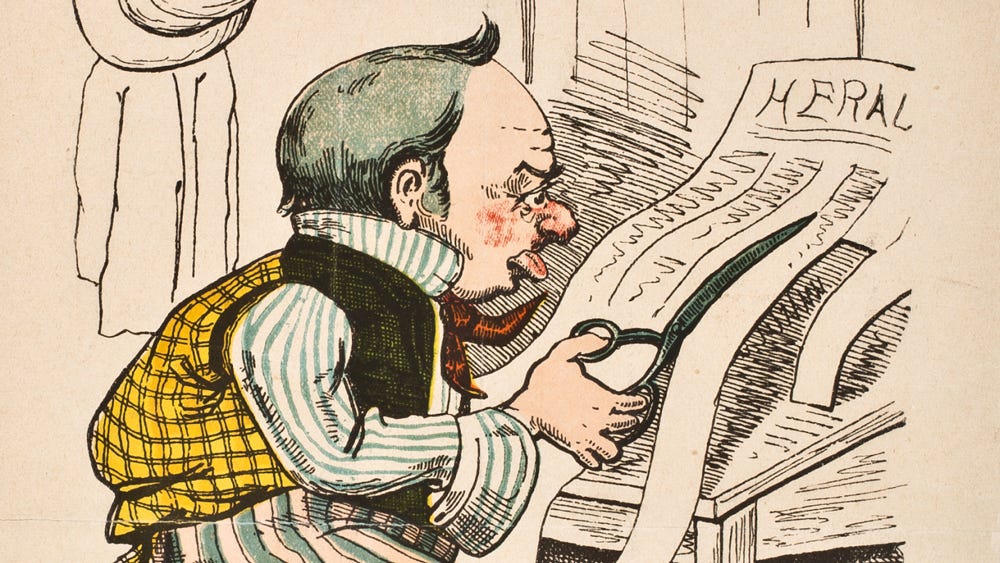
After the Revolution, developments such as nationwide mail delivery, federal subsidies, and relaxed copyright laws created a “vast, decentralized information network” that enabled papers to circulate widely among the public. However, the demanding work kept operations small, so editors played the role of content curators as much as creators. They borrowed popular stories and essays liberally from other papers, remixing them or just cutting them out with scissors to reproduce wholesale.
This essentially made news editors the influencers of their day, a comparison not lost on Wright:
“Seen through a contemporary lens, this vast analog exchange network anticipates many of the features we now associate with digital media: virality, reposting, moderation, and algorithmic remixing. In the endless stream of memes, viral videos, and reposted content that makes up our modern-day social feeds, we can see distant successors of precisely the kinds of content that used to circulate widely via the exchange networks [...].”
From these early days on, Wright explores a succession of technologies that helped make print faster, cheaper, and more efficient while circulating newspapers to an impressively literate public eager for more. These include the invention of paper pulp, steam-powered presses, and the Fourdrinier machine, alongside ancillary technologies like railroads and the telegraph.
The hinge moment comes with the Civil War. Small, portable presses — weighing only a couple hundred pounds — were developed, originally allowing soldiers to print camp newspapers before moving out West with settlers after the war. Railroads brought reporters to battlefields for on-site reporting, and telegraph dispatches allowed them to send up-to-the-moment news back home. A fact I did not know before reading: the Associated Press came into its own during this period, and its reliance on the telegraph led to the “clipped, economical, and deliberately anodyne” tone we associate with “hard news” today.
“[T]hese developments helped accelerate the transformation of the press from a hodgepodge of small-town partisan papers into an increasingly nationalized press chronicling the war in real time — and laying the groundwork for the professionalized industrialized mass media of the postwar era,” Wright writes, and the back half of the book follows that evolution.
Confident and written in a sure hand, Empire of Ink is every bit the crowd-pleaser a pop history should be. The only lurch comes in its final chapter, when Wright looks to the future of news in the age of search engines, social media, and influencer-created content. Here, he questions whether new media isn’t so much replacing “traditional” news as it is a kind of homecoming:
“We may not be witnessing the end of the news business after all but rather a historical reversion to form: a transition from a centralized, industrial-era model dominated by commercial for-profit publishers and salaried middle-class journalists to a more distributed and recombinant media ecology — an echo, however distorted, of the chaotic and pluralistic press culture of the nineteenth century.”
It’s a provocative idea, and Wright handles it with humility, warning that comparing today’s trends with their historical cognates, while “tempting,” can be inexact. He is also aware that this change has put the economic viability of journalism and its role as the fourth estate at risk.
Unfortunately, Wright’s prescriptions for addressing these changes are hazy. Rather than “foolishly” try to save legacy newspapers, he argues, we need to “fortify the information commons to ensure the health of the broader media environment.” And we do that by creating a framework of part-human, part-AI hybrid editors that will shape “the public sphere from the infinite scroll of digital content.”
Maybe? Like so many pop-history codas drawing lessons from the past, Empire of Ink tries to tie together too many tenuous ideas in its final pages, and I’m left unconvinced that we’re witnessing the return to a more democratized press culture and not simply shifting the locus of editorial power to a gaggle of technopreneurs unrestrained by the standards of accuracy, self-correction, and (mostly) impartial reporting.
Or perhaps that’s just my sentimentality for the newsroom flaring up again. As I said, it’s a minor lurch — one unfortunately placed right at the end — and I don’t read histories like Empire of Ink in search of solutions to our modern problems. I read them to better understand some facet of our shared past and maybe some solace in knowing that we aren’t alone in facing such challenges.
On that point, Wright agrees: “As we enter a still-uncharted digital future, we might take some comfort in knowing that we are not the first generation to wrestle with such a rapidly changing unstable media landscape.”


Kevin Dickinson is the books editor at Big Think. He holds a master’s in English and writing, and in addition to Big Think, his work has appeared in RealClearScience, Pop Matters, the Writer Magazine, and the Washington Post.
Big Think Books connects you to the ideas shaping the future—straight from the minds shaping it.
Check out more of Big Think’s content:
Big Think | Mini Philosophy | Starts With A Bang | Big Think Business
 | A guest post by
|
Enjoyed this, Kevin. Curious to know whether Wright makes much of Yellow journalism and its ‘pioneers’ - Pulitzer and Hearst and those who discovered just how profitable outrage could be.
A stunning piece
I’m glad I found you.
I'd love for you to check out my pieces and kindly connect back if it sticks.
https://lawrenceomoregiejr.substack.com/p/i-carried-the-weight?r=3g3d4k&utm_campaign=post&utm_medium=web&showWelcomeOnShare=true
https://lawrenceomoregiejr.substack.com/p/i-know-you-think-im-happy?utm_source=share&utm_medium=android&r=3g3d4k
https://lawrenceomoregiejr.substack.com/p/to-my-substack-family-561?r=3g3d4k&utm_campaign=post&utm_medium=web&showWelcomeOnShare=true
Would love to hear your thoughts as we grow together here.
Do have a great read and a lovely day